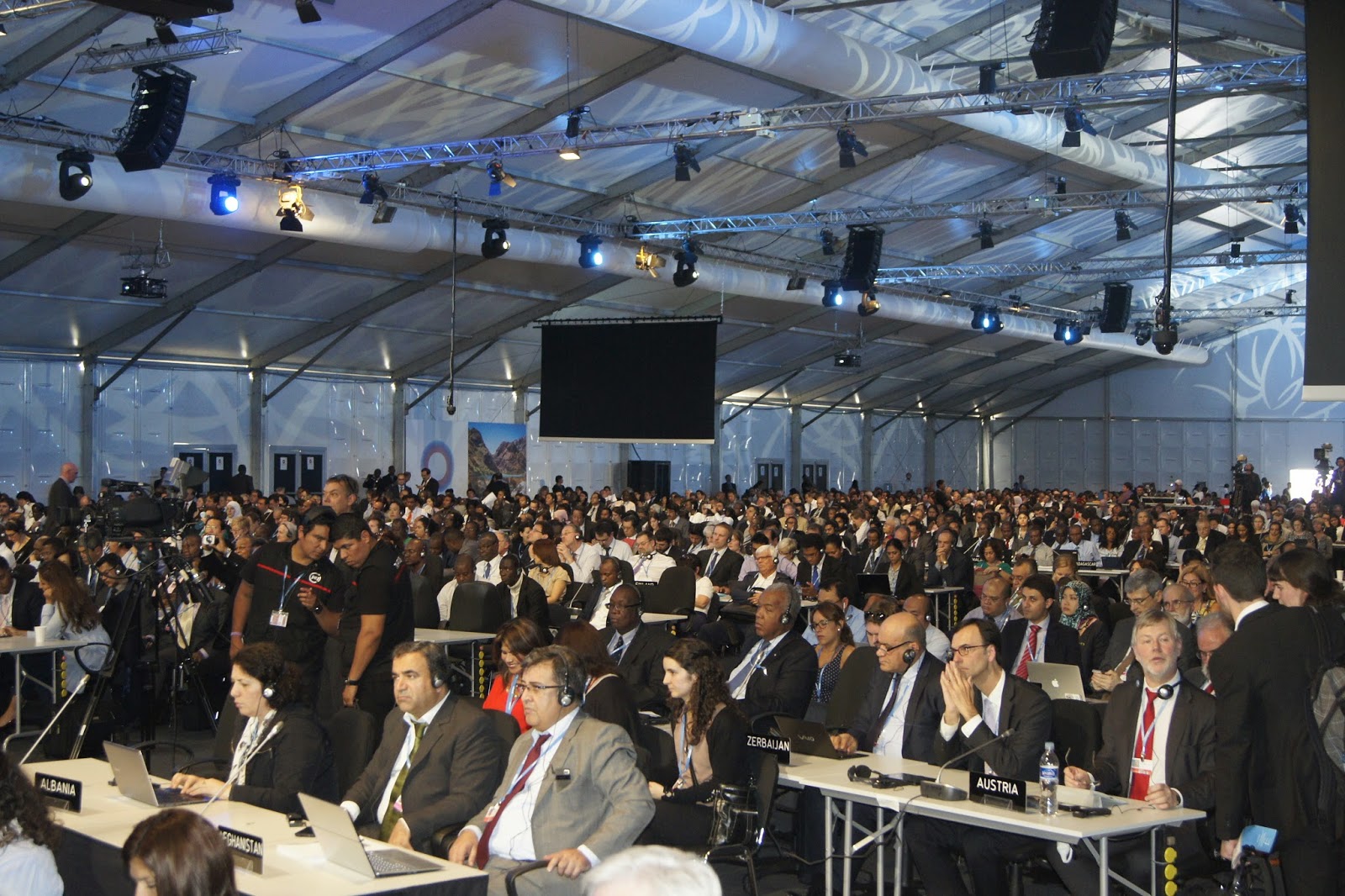
...This Agenda is a plan of action for people, planet and prosperity... We are resolved to free the human race from the tyranny of poverty and want and to heal and secure our planet…

Search This Blog

Monday, October 26, 2015

COP21 Paris – Africa at the crossroads in safeguarding development progress

Africa is at the crossroads of safeguarding development progress under an expanded Millennium Develop Goals (MDGs) whilst remaining faithful to the global call for action against climate change, says Mithika Mwenda, Secretary-General of the Pan African Climate Justice Alliance (PACJA).

According to him, the continent is the battle ground for competing global interest and as climate change acquires political-economic dimensions, African countries are squarely at the crossroads to decide which global grouping to side with.

“The continent is at the crossroad of choosing the fossil fuel-based development pathways or adopting low carbon development trajectory with its consequences of cost,” he said.

He therefore expects Africa to work harder to keep prospective speculators who would wish to take advantage of vulnerable African countries to serve their interest at the climate change talks in Paris in December 2015.

Mithika was addressing a Pre-CCDA workshop which is looking at what is a stake for Africa in Paris in “shaping an ambitious, sustainable, equitable and legally binding climate agreement”.

The Fifth Climate Change and Development Conference for Africa (CCDA-V) is holding Victoria Falls, Zimbabwe from October 28–30 on the theme: "Africa, climate change and sustainable development: what is at stake at Paris and beyond?"

Ahead of the event, the World Resources Institute (WRI) and PACJA are holding the workshop with the aim to contribute to Africa’s preparedness for COP21 and beyond.

Participants include African negotiators and other stakeholders within the continent, in particular civil society, legislators, private sector, and implementing agencies to strengthen capacity on key issues pertaining to the 2015 Climate Agreement.

“We need to think globally but act locally” when it comes to the issue of climate change, stated Yamide Dagnet of the WRI, a Think Tank.

The Pre-CCDA is assessing the options on the table on ambition cycles, adaptation, land use and forest, support, and by exploring capacity building needs related to implementation and the legal implications.

Zhakata Washington with the Zimbabwean Delegation to the UNFCCC has acknowledged African civil society speaks louder and more effective than governments in persisting to seek solutions.

To ensure implementation of decisions taken, he has tasked CSOs “to continue giving us [governments] the pressure”.

The Pan African Parliamentarian Network on Climate Change (PAPNCC) says it would be keeping an eye on the African Group of Negotiators, government representatives and other stakeholders to ensure the African position is upheld in the interest of people on the continent.

“We stand for one Africa, one voice and one position; it’s the only key of success and I believe very strongly that when we stand on this we’ll succeed in Paris,” said Cameroonian parliamentarian and Executive Secretary of PAPNCC, Awudu Cyprian Mbaya.

Africa contributes least to climate change but the people on the continent are most vulnerable to the impacts of the changing climate.


Story by Kofi Adu Domfeh, in Victoria Falls, Zimbabwe

Sunday, October 25, 2015

Draft Climate Change Agreement forwarded to Paris

The draft text of the new, universal climate change agreement and its accompanying decisions will be dispatched to Paris, where a final agreement will be reached in December 2015.

This follows five days of dedicated work in Bonn, Germany.

The draft text of the agreement enjoys full ownership by the governments of the world and represents a balanced text that will constitute the starting point for the final round of negotiations.

Negotiations will resume in Paris when governments meet at the Paris Climate Change Summit from 30 November to 11 December 2015.

UNFCCC Executive Secretary, Christiana Figueres said that the draft text includes additional options that reflect the concerns of all countries.

“We now have a Party-owned text that is balanced and complete. The challenge for governments is to bring it down to a much more concise and coherent form for adoption in Paris,” she said.

French Climate Change Ambassador Laurence Tubiana said: “We have a manageable text for further work in Paris. While much work remains, the text is a good basis for negotiations and negotiations need to start from the first day of the conference.”

Both Ms. Figueres and Ms. Tubiana agreed that the political process between now and the beginning of the Paris Summit will be central to the success of the meeting.

A Pre-COP Ministerial meeting will take place in the French capital in early November to further address the high-level political issues relating to the draft agreement.

The G20 Heads of State will meet in Turkey in mid-November, followed by the Heads of State meeting of the Commonwealth in Malta just before the Paris Summit opens.


The Fifth Conference on Climate Change and Development in Africa (CCDA-V) is also being convened by the UN Economic Commission for Africa in Victoria Falls, Zimbabwe on the theme: “Africa, climate change and sustainable development: what is at stake at Paris and beyond?” 

Wednesday, October 21, 2015

Surviving climate change through media mediation

In Ghana today, the rains are coming at unexpected periods, the sun hits hard than it should not have; the least of rains cause flooding and livelihoods are impacted in diverse ways.

This situation cannot be different from other parts of the world.

People are experiencing changing climatic times for real and indeed everybody seems to be talking about the severity of the change in weather patterns.

Yet the climate change agenda is not a top priority in the media – reports are often limited to government policy papers and other scientific stuff.

Kofi Adu Domfeh looks at how the media can play a central role in the global drive to mitigate climate change as well as support adaptation mechanisms.

Listen to audio report…


Tuesday, October 20, 2015

Mainstreaming Climate Change in Ghana’s politics

Climate justice activists going to Paris in December will be seeking political commitments from polluter nations to cut carbon emissions whilst funding adaptation programmes for the climate vulnerable.

The African Group of Negotiators (AGN), for instance, will be clamouring for the aspiration of vulnerable people on the continent to be upheld in the agreement.
Local farmers and communities would be the ultimate beneficiaries if a favorable deal is reached at the 21st Conference of Parties (COP21) of the United Nations Framework Convention on Climate Change (UNFCCC).

However, the benefits would only trickle down when implementation of the Intended Nationally Determined Contributions (INDCs) has strong political backing at the country level.

An INDC is both a government's political and technical proposed 'contribution' to the United Nations as to what it will do about climate change.

Ghana, upon submitting its INDC, joined the global efforts to put in fair and balanced future climate regime, which is expected to be agreed upon at the UN Climate Talks in Paris.

Ghana’s INDC will serve as the national blueprint on its enhanced climate action plan for 2020-2030.

The INDC is anchored on the Ghana Shared Growth Development Agenda II, National Climate Change Policy and the Low Carbon Development Strategy, as well as the anticipated 40-year long-term development plan.

Effective implementation of actions outlined in the INDC will largely depend on strong political will and commitment of the political party in power to deliver on the ‘contributions’.

In November 2016, Ghana will go into Presidential and Parliamentary polls.

There are already call for the mainstreaming of the country’s INDC in the manifestoes of political parties going into the General Elections.

“We are not interested in promises but we want promises that are doable. If we have these firmly in their manifestoes, then the political parties have it as an obligation to implement these things,” said Sam Kobina Afena, a rural youth development practitioner at a national forum on Ghana’s INDC.

According to him, “the politician must be seen to be championing the cause of the people; we have to demand from them because they are coming to us for votes; so we should name our terms and that is our developmental needs”.

Climate change is indeed a development issue – it can deny people and communities their ability to overcome poverty.

“Climate is a very critical issue; infact this year, we are only praying for a miracle to happen otherwise next year will be very critical for food production because the rains came very late,” observed Sam.

Ghana’s Environmental Protection Agency (EPA) has been holding awareness creation meetings with various stakeholders on the INDCs.

The objective is to solicit comments and recommendations for post-2015 review of the INDC and readiness activities as well as discuss implementations strategies.

Dr. Emmanuel Tachie Obeng at the EPA’s Climate Unit says there plans to engage the political parties to commit to the INDC.

“We have series of awareness creation for the politicians so that the INDC is going to inform their manifestoes,” he said.

There are expectations that progress on the Sustainable Development Goals (SDGs) should encourage parties at the COP21 to come up with a strong, fair and equitable climate agreement.


Strong engagements will also ensure that parties at the national level are delivering on the climate needs of local people.

Story by Kofi Adu Domfeh

Monday, October 19, 2015

Asantehene to address Chatham House on threats to global peace and security

The Asantehene, Otumfuo Osei Tutu II, will address a high-level audience at Chatham House in the United Kingdom on the escalating threats to global peace and security on October 30, 2015.

For over 80 years, the Chatham House has provided a unique platform for statesmen and great thinkers across the world to articulate ideas that contribute to peace and the building of a better world.

Among the icons of history who have been heard from Chatham House are Mahatma Gandhi, Nelson Mandela and the recent Muamar opposition leader, Ansa Suu Kyi.

“The engagement with Otumfuo signifies the recognition of the role he can play as a global peace maker in a troubled world,” said the statement from the Manhyia Palace, signed by Chief of Staff, Kofi Badu.

As guest of the Cambridge University and the Royal Institute of International Relations, the King will also undertake a number of functions in the UK.

The Asantehene will be the Guest of Honour at this year’s Cambridge-Africa Day, which is celebrated at Cambridge University on October 23, 2015.


“At the invitation of Lord Williams, former Archbishop of Canterbury and now Master of Magdalene, Otumfuo will deliver the keynote address at a function to mark the re-launch of an endowment for a full time Nelson Mandela Professor of African Archaeology at the University on October 24,” said the statement.

Saturday, October 17, 2015

Ghana’s first Islamic Investment Fund launched in Kumasi

An Islamic Investment Fund has been launched in Kumasi with the objective of reviving economic activities within Muslim communities.

The Shari’a complaint financial system is to mobilize funds from the Muslim Ummah for development, whilst creating jobs for the teeming youth in need of jobs.

The Fund is initiated by the Ahlussunna WalJama’a Ashanti Regional Imam (ASWAJ) to offer “ethical investment” tools to investors seeking to invest in profitable “halal” business ventures which have minimal risk but good potential for growth.

“Usually our interest according to Islam is ‘halal’, our economy based on helping the poor not to take the little from the poor; we always want to help the poor,” noted Sheikh Dr. Ismail Saeed, ASWAJ Imam. “So here we are using it as a starter to pull all our resources together, and when they start getting something, then in future when it becomes a bank it will be an encouragement for them [to invest]”.

A Gh100,000 is to be raised in the initial public offering of 200 shares at a share value of Gh500 per share.

The Fund seeks a combination of capital appreciation and current income for shareholders.

The investment plan is established along three minimum risk areas: short term businesses – Cattle Rearing, Washing Bay and Cash-Crop Farming; medium term – Transportation and Commodity Trading; and long term – Real Estate Development, Islamic Microfinance, Project financing and Venture capital.

A 25-member Business Implementation Committee, Chaired by a banker, Issah Mallam Ahmed, was inaugurated at the IPO launch at Sawaba, a predominantly Muslim community in Kumasi.

Municipal Chief Executive for Asokore Mampong, Alhaji Nurudeen Hamidan, is among the first to invest in the Fund.

He is confident Ghana will soon have a number of Islamic Banks spread across the country because of the high profitability based on the “interest and cost sharing principle”.

“In Islamic Banking, the 100% profit is shared accordingly, as against the traditional banks that we have here where a percentage is given to you as profit or dividend on your investment and the bulk of the money is kept by the bank for their operations,” he observed.

Islamic Scholar, Sheikh Osman Bawa Hafiz Olando, is confident the Fund will empower Muslims and reduce crime rates in Muslim communities across the country.

“It is our responsibility as individuals, organizations, churches and mosques, associations to come up with those jobs for our children and grandchildren to have something to do so that they can uplift their lives and localities for a better Ghana,” he said.


Story by Kofi Adu Domfeh 

Friday, October 16, 2015

Chiefs in Kumasi asked to engage professionals in land management

Good Governance Africa (GGA), an independent research and advocacy organization, has been engaging chiefs and other interest groups in land administration on security of property rights in Ghana.

Private enterprises in the country often need collateral to access finance to promote their operations and these businesses should be able to use their lands as collateral. But there are challenges with rights of property owners in the country.

According to GGA-West Africa, security of property rights, protected by the rule of law, provides the foundation for both economic freedom and the efficient operations of markets.

The organization has observed that “most individuals and corporations have fallen victims to the weak laws and institutions which are mandated to protect them and their properties”.

GGA-West Africa Centre organized a workshop to openly discuss the rights of a land owner, vis-à-vis the responsibilities of the custodians for the various stakeholders on the theme: ‘The rights of a property owner, challenges of owning a piece of land in Kumasi.’

Chief Executive Officer of GGA-West Africa, Tina Asante-Apeatu, has expressed satisfaction in outcomes of the Kumasi meeting.


“There is the perception that from tradition the chiefs know nitty-gritty of acquiring land, registration and all those things involved; but from the programme, we’ve realized that some of the complains the citizens have, the chiefs themselves don’t know. They so some of the things they do out of pure ignorance of the law,” she observed.

This workshop sought to outline the various laws that govern land administration; identify the challenges in enforcing the laws governing land administration; sensitize land owners and make recommendations to the mandated land administration institutions.

Land Economist with the Kwame Nkrumah University of Science and Technology (KNUST), Prof. Seth Opuni Asiama says Ghana can learn from other countries.

He cited Rwanda as an African country that have succeeded in registering every piece of land “so even if it’s a customary landholding, they’ve registered it” which gives the owner the confidence to deal in his lands.

In Ghana, however, a land owner seeking at give out a property on mortgage would need the consent of the chief, as custodian of the land, who in the process may demand money.

Prof. Asiama says traditional authorities would need to engage professional in the prudent management of lands.

“We should be more proactive in ensuring that we improve the security of title for our people because a lot of the problem we’re seeing in Kumasi today is because there are no professionals involved, who will be able to advise them on what to do with their lands,” he stated. “There is no reason why in this day and age there should be multiple sale of land simply because the chief does not have records; no it shouldn’t happen”.


GGA-West Africa hopes to develop policy briefs from the recommendations in the series of workshops to effect the necessary changes in land administration.

Thursday, October 15, 2015

Kumasi industries exposed to concept of turning waste to wealth

Businesses under the Chamber of Commerce and Industry in Kumasi have been exposed to a new environmentally-conscious concept that connects industries and creates business opportunities.

The Ghana Industrial Symbiosis Programme (GhISP) supports industries to develop smarter ways of resource and waste management.

Ghana is among three countries in Africa to tap into the opportunity, which is supported by the Industrial Symbiosis Limited (ISL) UK and funded by the European Union (EU).

International Manager of ISL, James Woodcock, led a workshop to introduce businesses in Kumasi to industrial symbiosis, including how to turn their waste into resource to save money, create new business opportunities and improve their environmental performance.

Coordinator of the Ghana Programme, Richard Mensah, says there are benefits in effective environmental management, noting that better management of resources will make local businesses attractive for investments.

He emphasized the application of the “waste hierarchy” concept of reuse, reduce, recycle, reengineer and dispose to ensure that waste is turned into a resource.

According to him, “if waste is seen as a resource then it can be diverted to do other things”, including energy from waste, fertilizer production and manufacturing processes.

Executive Secretary of the Chamber of Commerce and Industry, Fosu Yeboah, says the inherent benefits of industrial symbiosis make it worthwhile to adopt.


“There will be reduction in cost of managing their waste; a lot of money is spend on waste management but with this improved system, we envisage a situation where there will be a huge cut in the wage bill,” he said. “Most of this waste could also be turned into raw material for other companies, so there is financial gain here; instead of sending the waste into the landfill, they are now going to sell to other companies as raw materials”.

Friday, October 9, 2015

Private sector investments are shifting to address Climate Change

Private sector investments are shifting to address the challenges posed by climate change.

This trend could accelerate if governments and policy-makers take further actions to increase the demand for low-carbon, climate resilient investment, according to a report released by the United Nations Secretary-General’s Climate Change Support Team.

The new report, “Trends in Private Sector Climate Finance,” found that the private sector had made significant strides in response to the challenge posed by climate change since the 2014 Climate Summit in New York, where a range of finance sector including leaders from banks, pension funds, insurers and asset managers announced a series of high-profile commitments and targets to increase climate finance.

The report argues that the private sector has led the effort so far, but that now it is time for the policy makers to take action in order to accelerate the pace of private sector investment and engagement.

The report was presented to finance ministers at a special gathering in Lima, Peru that was jointly convened by France and Peru at the margins of the Annual Meetings of the World Bank Group and the International Monetary Fund.  It is a major milestone meeting, coming just over a month before countries meet in Paris to conclude a universal climate change agreement.

According to the new report, not only are most of the commitments made by the private sector at the Summit on track to being realized, moreover, hundreds of billions of dollars have been invested since the Summit to support low-carbon and climate-resilient investments in all parts of the world.

The increasing drive by the private sector, in both developed and developing countries is one of a series of trends that will help reduce emissions and improve climate resilience while providing energy, reducing air pollution and delivering a host of other benefits.

The report lists five inflection points that are signaling long term shifts. In addition to direct investments by the private sector, there has been the creation and expansion of the green bond market, which will issue between US $50-70 billion for climate finance in 2015.


Other shifts include: the increased application of internal carbon pricing by companies that will determine investment opportunities; increased concern around the activities of carbon-intensive assets and companies; and the sustained scaling up of efforts by the insurance sector to respond to the climate impacts that are already locked in.

The report also highlights that despite these long-term signals, serious gaps remain. Low-carbon investments remain insufficient to put the world on a less than 2°C degree pathway, particularly in the developing countries, despite a finding that investment in renewables in emerging and developing countries are outpacing that of OECD members.

While the public sector has a vital role to play to help the world reorient itself to a low-carbon, climate-resilient future, the report concluded that the bulk of the financing and insurance driving the much needed transition will be provided by the private sector.

UN Secretary-General Ban Ki-moon told the 70th Session of the UN General Assembly in September that “Climate finance will be crucial,” and he urged developed countries to meet the agreed goal of $100 billion per year by 2020.

The report does not address the ongoing negotiations within the UNFCCC as to what constitutes climate finance or on what should be counted towards the goal of mobilizing $100 billion a year by 2020 to address the needs of developing countries. Rather, it provides details on the progress made on the commitments and targets set by the private sector and the changes in the financial markets that are emerging.

The report states that the private sector has emerged more fully as a partner since the 2009 Climate Conference in Copenhagen. Action in the finance sector coalesced, and received a substantial boost, at the 2014 Climate Summit, which was “born of a recognition that the UN itself needed to change in order to facilitate the economic transition,” and aimed to bring together all actors with a role in addressing climate change to catalyze creative ideas and engender new partnerships.

Thursday, October 8, 2015

Mobile contribution to African economy surpasses $100 billion

The mobile industry in Sub-Saharan Africa contributed more than US$100 billion to the region’s economy last year, according to a new GSMA study.

‘The Mobile Economy – Sub-Saharan Africa 2015’ study finds that the US$102 billion economic contribution in 2014 was equivalent to 5.7 per cent of the region’s GDP.

Mobile operators directly contributed US$31 billion, representing 1.7 per cent of GDP. This economic contribution is set to increase over the coming years as mobile operators continue to extend connectivity to unconnected populations across the region and roll out new mobile broadband networks and services.

The industry is forecast to contribute US$166 billion in value to the region by 2020, equivalent to 8 per cent of expected GDP by this point.

“The mobile industry remains a key driver of economic growth and employment in Sub-Saharan Africa, making a vital contribution given the population growth and high unemployment levels seen in many countries in the region,” said Alex Sinclair, Acting Director General and Chief Technology Officer at the GSMA. “Despite revenue and margin pressures, local mobile operators continue to invest heavily to extend network coverage to serve unconnected communities and accelerate the migration to high-speed 3G/4G mobile broadband networks. Mobile technology is also playing a central role in Sub-Saharan Africa by addressing a range of socio-economic challenges, particularly digital and financial inclusion, and enabling access to vital services such as education and healthcare.”

The World’s Fastest-Growing Mobile Region

It is forecast that there will be 386 million unique mobile subscribers in Sub-Saharan Africa by the end of this year, equivalent to 41 per cent of the region’s population.

The region’s subscriber base has grown by 13 per cent a year (CAGR), on average, during the first half of this decade (2010 to 2015), growing at more than twice the rate of the global average (6 per cent) during this period.

The region overtook Latin America in 2014 to become the world’s third-largest mobile subscriber market, behind only Asia Pacific and Europe. The number of unique mobile subscribers in Sub-Saharan Africa is forecast to surpass half a billion (518 million) by 2020, representing almost one in two (49 per cent) of the region’s population by this point.

Total mobile connections in Sub-Saharan Africa are on track to reach 722 million by year-end. Mobile broadband (3G/4G) will account for almost a quarter of connections this year, but will increase to 57 per cent by 2020, driven by expanding mobile broadband network coverage and falling device costs. 

Commercial 3G networks have been launched in 41 countries across Sub-Saharan Africa as of June 2015, while 4G networks have been launched in 23 countries.

Investment in these high-speed networks is resulting in a corresponding growth in consumers using their devices to access the internet; almost a quarter (23 per cent) of the Sub-Saharan African population will be using the mobile internet this year, a figure forecast to rise to 37 per cent by 2020. Mobile is seen as the primary means of accessing the internet in a region where fixed-line infrastructure is severely limited. 

The increasing availability of mobile broadband networks, alongside the introduction of affordable mobile data tariffs and falling device prices, has led to a surge in smartphone use.

The smartphone adoption rate has doubled over the last two years and now accounts for one in five connections, though this is still half the global adoption average (40 per cent). It is predicted that regional smartphone connections will reach 540 million by 2020, accounting for half of total connections by that point. The report notes that the average selling price (ASP) of smartphones has fallen significantly in most regional markets, with an increasing number of models now available in the sub-US$100 price range.

Investing In Jobs, Networks and Innovation

In 2014, the mobile ecosystem directly employed approximately 2 million people in Sub-Saharan Africa, with the majority working in the distribution and retail sectors and approximately 325,000 employed by mobile operators. A further 2.4 million jobs were indirectly supported as result of the demand generated by the mobile sector, bringing the total to 4.4 million. 

It is forecast that the industry will grow to support more than 6 million jobs by 2020. The mobile ecosystem also made a contribution to the public finances of the region’s governments via general taxation of approximately US$15 billion in 2014.

Mobile operators in the region invested US$9 billion in network infrastructure development in 2014, a 16 per cent increase on the amount invested in 2013. The ongoing investment in mobile broadband networks will see capital investments reach US$13.6 billion by 2020.

The report highlights how mobile operators are working on innovative solutions to expand network coverage to underserved populations in rural and geographically remote areas, and to tackle the barriers to mobile phone adoption, including affordability and digital literacy. 

It also indicates that mobile operators, governments and international development organisations have been working on a range of mobile-based solutions to address a variety of social challenges in the region, many of which arise from lack of access to essential services, such as basic education and health.

“Mobile is having a hugely positive and transformative impact across Sub-Sahara Africa, but future progress will depend on governments working with the industry to provide a regulatory environment that encourages investment and innovation,” added Alex Sinclair.


Wednesday, October 7, 2015

The place of agriculture in Ghana’s climate adaptation actions

Ghana’s agricultural sector, the largest employer of the economy, has been the hardest hit this year by unfavorable weather.

Farmers across the country have recorded poor crop production because the rains failed them.

Without access to irrigation facilities, the local farmers are at the mercy of the weather to till and manage their farm lands for food production.

The extreme climate variability therefore means agriculturists can no longer plan the cropping season with the weather, a situation that threatens food security.

The changing climate is a reality to these farmers; not only in Ghana but across Africa.

At the continental level, the NEPAD Agency of the African Union is spearheading the Africa Climate-Smart Agriculture Alliance (CSA), with a goal of reaching 25million farm households by 2025.

“For many years now we’ve heard voices and witnessed the effects of climate change on agriculture in our continent; crop failures and death of livestock have become more frequent, leading to economic losses, undermining food security and contributing to higher food prices,” observed Estherine Fotabong, NEPAD Programmes Director.

She added that “In order to make rural transformation attainable, climate change needs to be also mainstreamed in the Comprehensive Africa Agriculture Development Programme (CAADP), Africa’s instrument for agricultural growth and economic development”.

Climate Smart Agriculture – a system that produces more food on less land, while being weather resistant and absorbing carbon – is being pushed by the World Bank and the Global Alliance for Climate Smart Agriculture.

Ghana’s economy relies heavily on climate sensitive sectors mainly on agriculture, energy and forestry. With less than one percent of cultivated land under irrigation, farmers are vulnerable to unfavourable climatic conditions.

“Total rainfall amounts are projected to fall or experience great variability which will impact crop production and the livelihoods of many in rural areas,” as stated in the National Climate Change Adaptation Strategy.

Strategies under agriculture include goals to “build and strengthen capacity of local farmers to increase agricultural productivity and awareness of climate issues” and to “build and strengthen capacity of extension officers in new farming technologies in order to enhance their support for farmers”.

Ghana’s actions for climate mitigation and adaptation are contained in the country’s Intended Nationally Determined Contribution (INDC) submitted to the United Nation’s climate change negotiation process.

Sustainable land use, including food security, is among the seven priority economic sectors being proposed for implementation in the 10-year period (2020-2030).

The INDC Adaptation Policy Actions focus on “Agriculture resilience building in climate vulnerable landscapes” to be implemented along the lines of the country’s Food and Agriculture Sector Development Policy, Ghana’s Medium-term Agriculture Sector Investment Plan and the Ghana Agriculture Investment Programme.

A total investment of $3.18billion is needed to implement agriculture-related programmes of action – representing about 14% of the total $22.6billion climate implementation investment.

The three areas of investments include: scale up penetration of climate smart technologies to increase livestock and fisheries productivity by 10%; promote innovations in post-harvest storage and food processing and forest products in 43 administrative districts; and modify community-based conservation agriculture adopted in 43 administrative districts.

For the local farmer, the December 2015 Climate Talks in Paris should produce valuable outcomes to deliver interventions under national and international policies.

Such interventions must come in fast and flexible to enable farmers quickly adapt to the changing climate to protect their livelihoods and sustain economic development.

Story by Kofi Adu Domfeh 

Translate

Popular Posts