...This Agenda is a plan of action for people, planet and prosperity... We are resolved to free the human race from the tyranny of poverty and want and to heal and secure our planet…

Search This Blog

Showing posts with label Agenda 2030. Show all posts

Friday, March 5, 2021

Countries asked to ensure full representation towards achieving SDGs #ARFSD2021


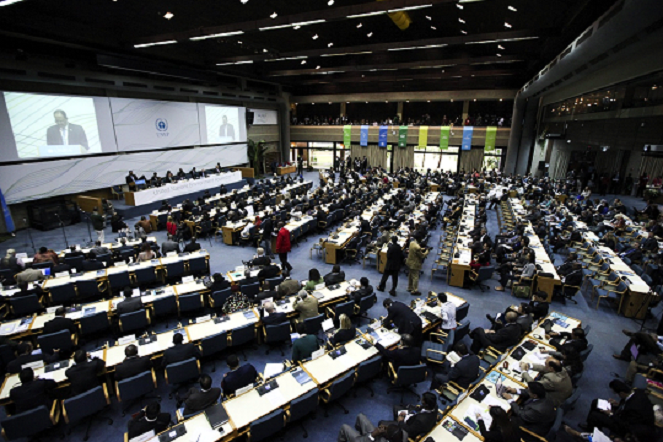
The Seventh Session of the African Regional Forum on Sustainable Development (ARFSD) has ended with a call on African countries to pursue full representation of all citizens, including women, children, and the disabled, irrespective of background, belief or geographic location, in efforts to attain the sustainable development goals without leaving anyone behind.

During the four-day Forum, discussions showed that efforts by countries, including achievements made in achieving the SDGs and Agenda 2063, have been severely affected by the COVID-19 pandemic, setting back strides in addressing the continent's development needs.

The Forum, hosted by the Government of Congo Brazzaville and held virtually, also called on governments to ensure peace and human security, remove restrictions on spaces for activists and journalists and work to avoid election violence.

The Forum also emphasized the importance of data which is a key component of tracking the SDGs. In this regard the UN Resident Representative in Zambia, Ms. Coumba Mar Gadio stated that the UN has worked with the Zambian government to mainstream the SDGs and provided support to localize SDGs and national planning.

That, she said, was to ensure that the national plan followed a strategy to apply the SDGs.

Ms. Joy Kategekwa, Head, UNCTAD Regional Office for Africa, called for a regional approach in procurement as the continent continues to fight COVID-19; urged the continent to fight corruption; and added that the African Continental Free Trade Area (AfCFTA) should also work for women and young people.

In spite of the challenges, there are some success stories, as narrated by Ms. Micheline Baussard of the UNDP. She indicated that cooperation among regional groups has led to new initiatives and called on countries to develop a roadmap for attaining the SDGs.

“There is need to invest in human capital in the implementation of this roadmap,” she said, adding that “90 per cent of the goals are related and therefore impact from one goal will affect the other.”

Ms. Edith Madela-Mntla of the University of Pretoria urged that the process of implementing the SDGs should be people-centred and inclusive. The homeless, disabled and marginalized should be included in the process, she added.

Ms. Madela-Mntla also called on countries to pay attention to climate change and the environment; and look at how to manage COVID-19 related waste, think of how to deal with disasters, cyclones, floods and disasters and ensure low carbon emissions.

Among the key highlights of the Forum’s resolutions, which would be reviewed by member-countries till March 14, 2021, include the need for countries to pay attention to data collection and the Voluntary National Reviews and Voluntary Local Reviews. The need for the SDGs to address poverty and gender across all sectors; reducing illicit financial flows, reinforcing small-holder farmers and looking at using the AfCFTA to create jobs in the agriculture sector.

Participants also called on governments and the private sector to enhance value chains across the continent and the use of innovative financing to address climate change.

The forum was held under the theme; "Building forward better: towards a resilient and green Africa to achieve the 2030 Agenda and 2063".


Wednesday, September 30, 2015

Time to walk the talk on sustainable development goals

As the UN’s Sustainable Development Summit closed in New York with a bold new global sustainability roadmap, world leaders now need to focus on fulfilling that vision.
The task ahead is clear, but not easy – world leaders must go home and make the necessary administrative, legal, regulatory and fiscal decisions, and spend the next 15 years implementing and enforcing this agenda.
Unlike the Millennium Development Goals that were mainly aimed at developing countries, for the SDGs, all goals have to be achieved in all countries.
The Agenda 2030, which contains the 17 SDGs, agreed upon by countries, with the participation of other actors in an unprecedented democratic process, necessitate important transformations. Leida Rijnhout, Director of Global Policies and Sustainability at the European Environmental Bureau, stated that the new development goals present an opportunity to transform the world’s development agenda.
“The Sustainable Development Goals should give some much needed impetus for a paradigm shift to a new global economic and political system based on sustainability, human rights and equality,” states Leida.

For this to happen there’s need for a clear political and moral will to implement the SDGs.
“Governments have to use their political and moral power to put the right policies in place and mobilise all means of implementation to enable the shift away from business-as-usual,” states Leida.

Political will
In his speech to the UN General Assembly, Pope Francis stated that “solemn commitments are not enough, even though they are a necessary step toward solutions.” He further reiterated the importance of political and moral will in the achievement of the SDGs.
“Our world demands of all government leaders a will which is effective, practical and constant, concrete steps and immediate measures for preserving and improving the natural environment and thus putting an end as quickly as possible to the phenomenon of social and economic exclusion.”
UN Secretary General Ban Ki-Moon cautioned that the true test of commitment to these goals “will be implementation. We need action from everyone, everywhere”. He added that the goals “are a to-do list for people and planet, and a blueprint for success.”
“To achieve these new global goals, we will need your high-level political commitment. We will need a renewed global partnership,” he said.
WWF International President Yolanda Kakabadse urged world leaders to sustain this political courage at home and make the right choices, committing to a total economic, social and environmental overhaul.

“Today’s celebration must translate into delivery and quickly. For these goals to become a reality decision-makers must demonstrate their intention to implement the 2030 Agenda and its Sustainable Development Goals is real and make their efforts transparent through careful follow-up and review,” urged Kakabadse.
Countries need to figure out how they’re going to contribute to achieving these goals and set benchmarks and indicators so they can report on their efforts. They will need to strengthen their domestic and external mobilization of resources to implement this development agenda.
Addressing the UN General Assembly, Kenyan President Uhuru Kenyatta stated that the goals are ambitious and need an equally robust development mechanism.
“Without resources, the goals may never be realised; effective mobilization of resources in the context of global partnership will be critical,” he said before adding “new ideas and courage are necessary in achieving the Sustainable Development Goals (SDGs).

Integrating Gender in SDGs
Winnie Byanyima, Executive Director of Oxfam International said that the new Sustainable Development Goals are ambitious on paper but they could be historic in their impact.
“SDGs seek to go beyond band-aid solutions by setting out to eradicate – not just reduce – extreme poverty and hunger in every country,” she said.
Winnie further warned that the successes of the SDGs  requires the participation of the most vulnerable and marginalized people so they can hold their governments to account and claim their rights. Women must be central to realizing these goals, while at the same time the concentrated power of vested interests must be challenged and those interests held more accountable by governments and citizens.
Alicia Bárcena, Executive Secretary of the Economic Commission for Latin America and the Caribbean (ECLAC) echoed the integration of women and other vulnerable groups in implementing the SDGs.

“Sustainable development must include gender equality comprehensively, otherwise it is neither development, nor sustainable. The time for equality has come,” stated Alicia.
The 2030 Agenda should be centered on participatory and transparent processes that turn the top-down logic on its head and move from the national arena to a regional sphere, and from regional to global.
Every country is required to develop national indicators and programmes of implementation through individual development plans. In March, countries will crucially agree a set of indicators that will allow the UN to report annually on global progress in coming years.


Sustainable development demands significant collective action. Though all 193 Member States of the United Nations reached agreement on the SDGs, their success relies heavily on action and collaboration by all actors. Just as Winnie Byanyima of Oxfam correctly puts it, “Our political leaders have set the goals. There is a collective responsibility now to achieve them.”

Translate

Popular Posts