...This Agenda is a plan of action for people, planet and prosperity... We are resolved to free the human race from the tyranny of poverty and want and to heal and secure our planet…

Search This Blog

Showing posts with label EU. Show all posts

Monday, October 7, 2019

EU plants trees in Ghana to mark Climate Diplomacy Week

The European Union Delegation to Ghana has collaborated with the Kumasi Metropolitan Assembly to undertake series of events to re-green Ghana, as part of activities marking this year's Climate Diplomacy Week.

The Climate Diplomacy Weeks are organized all over the world by EU Delegations to create awareness on the impact of climate change in the world.

They are also meant to strengthen the global response to the threat of climate change in the context of sustainable development.

Last year, the week was dedicated to reducing, reusing and recycling waste. This year, the theme is reforestation, with the slogan #RegreeningGhana.

Head of the EU Delegation to Ghana, Diana Acconcia, has urged Ghana to sway from the mistakes of advanced economies which relied on the use of coal and rather adopt innovative and cleaner sources of energy to power its industries.

“We have the duty to leave behind a healthier planet, more stable, fairer societies and more prosperous and modern economies for future generations. Climate change is a direct and existential threat. It spares no country and requires a collective response,” she said.

A regreening workshop in Kumasi attracted youth organisations, students from local high schools, local professional schools, University students and alumni and other local organisations and youth groups.

It afforded them the opportunity to engage in a frank but constructive exchange with politicians, businesses and other stakeholders to express their concerns and requests for climate action.

The purpose of the workshop was to give examples of green initiatives that contribute to make societies more resilient and green.

In line with this, 30 trees were planted along the Kumasi Cultural Centre, while selected school children planted trees at the Asokwa and Kumasi Municipalities.

The Chief Executive of the Kumasi Metropolitan Assembly (KMA), Osei Assibey Antwi, said the partnership and knowledge sharing offered by the EU Delegation to restore the forest cover will strengthen the campaign to grow more trees.

To mark the EU Climate Diplomacy Week, 240 trees are being planted in Ghana.

The EU has been at the forefront of international efforts to fight climate change.

“Under the Paris Agreement, the EU has committed to a cut of at least 40% in greenhouse gas emissions by 2030 compared to 1990,” said Diana Acconcia.

By Kofi Adu Domfeh

Friday, May 31, 2019

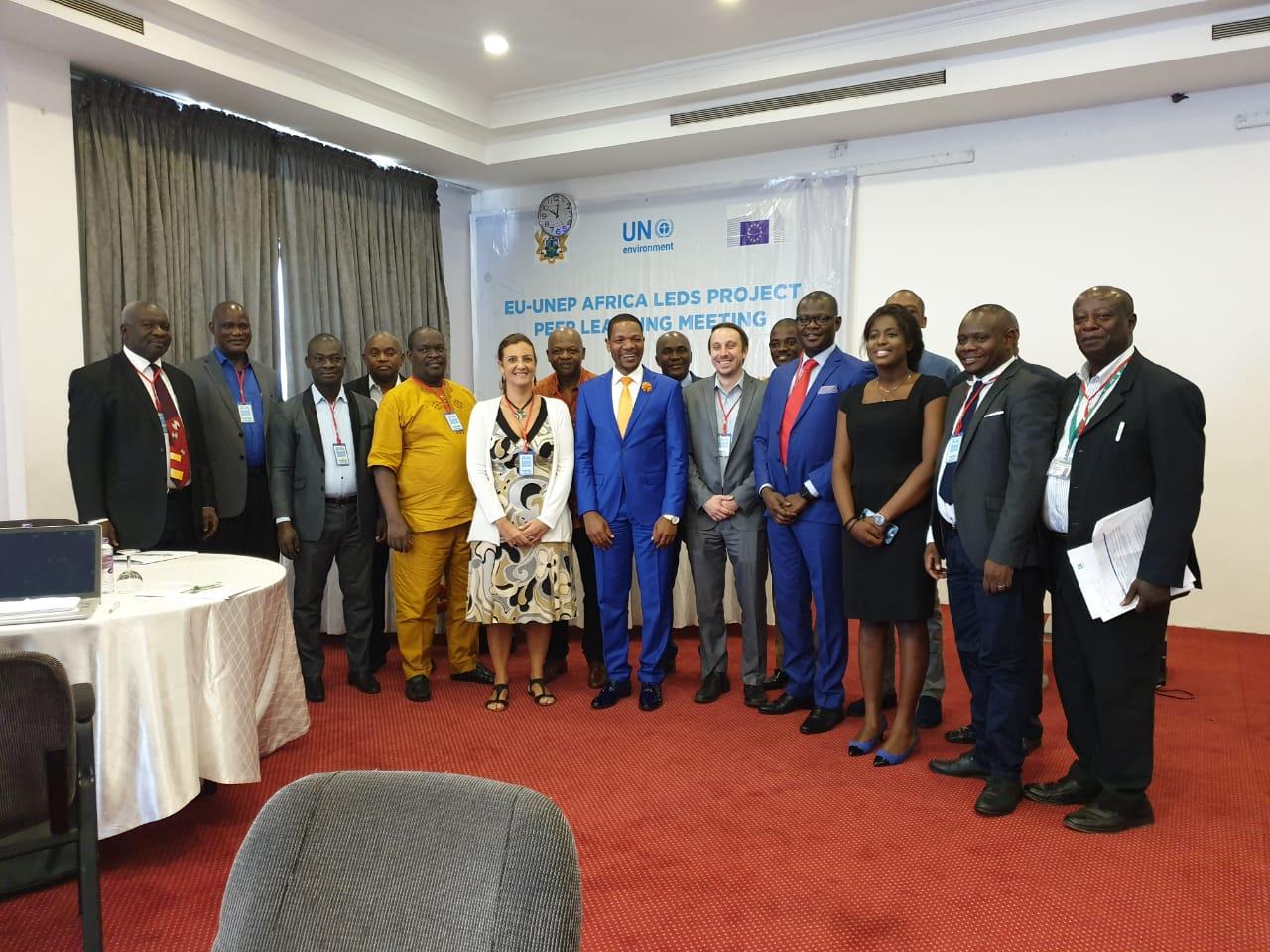
EU-UNEP Africa LEDS Project sets pace for climate action on the continent

The little steps African countries are taking in transitioning to low emissions pathway are what will see the continent achieve climate compliance by 2030, as called for in the Paris Climate Agreement, says Dr. Richard Munang, UN Environment Africa Regional Climate Change Coordinator.
 
He believes countries’ Nationally Determined Contributions (NDCs) in the areas of agriculture, energy and forestry can be combined to maximize bottom line emissions reduction and amplify socioeconomic benefits of income creation and job opportunities in ancillary sectors popular with engaging the youth, especially ICT.

Dr. Munang was addressing a peer learning and closeout meeting of the EU-UNEP Africa Low Emissions Development Strategies (Africa LEDS) Project in Accra, Ghana, under the theme: “Unlocking Socioeconomic Opportunities Through Low Emissions Development Actions”.

Emphasizing that “there is no beauty but the beauty of action”, Dr. Munang said there is the need for innovative paradigms and actions to accelerate the realization of socioeconomic and climate benefits for the people of Africa.

“The sustainability and longevity of climate actions in the continent depends on how well they demonstrate socio-economic value,” he said. “This is especially so considering that while Africa is negligible emitter, it stands out as the most vulnerable to climate change, with vulnerability driven primarily by the prevailing low levels of socioeconomic development”.

The implementation of the EU-UNEP Africa LEDS project has demonstrated through ground actions and investment support tools, that strategic implementation of NDC priorities aligned to key socioeconomic sectors can maximise both climate and priority socioeconomic benefits simultaneously.

The Project is urging governments in Africa to create an enabling environment for low emissions development strategies uptake, leveraging on strategic implementation of ambitious NDC commitments.

The seven project partner countries include Cameroon, DRC, Cote D’Ivoire, Ghana, Kenya, Mozambique and Zambia.

Ghana, for instance, is of the firm belief that tacking climate change would help strengthen the resilience of the economy against shocks.

The current national development plan for Ghana, therefore, recognizes climate change as one of the developmental challenges and has developed policy interventions to address it in the medium-term.

“The policies set out in the national development plan informed the adaptation and mitigation actions that Ghana put forward in the first-round of its Nationally Determined Contributions (NDCs),” said John Pwamang, Acting Executive Director of Ghana’s Environmental Protection Agency.

He observed that though Ghana’s share of global greenhouse gas emissions is low, the mitigation measures being implemented are aligned to the low emission trajectory of the EU-UNEP Africa LEDS Project.

The Project is premiering LEDS modeling as a direct enabler of socio-economic development with actions targeted at sectors that could unlock socioeconomic development opportunities alongside offsetting carbon.

Susana Martins, Programmes Officer, Infrastructure and Sustainable Development at European Union Delegation to Ghana, emphasized the commitment of the EU to finance climate change interventions in Africa.

“We are committed to the implementation of projects on climate change,” she said.

The Africa LEDS Project is a partnership between the European Commission, UNEP, the LEDS Global Partnership, Africa LEDS Partnership and seven collaborating countries. The project has enabled significant progress on low carbon transformation in Africa.

By Kofi Adu Domfeh

Wednesday, May 2, 2018

Fossil fuel industry fingered for delayed climate action

The fossil fuel industry has been active in lobbying for delays in global climate action as they stand to make enormous amounts of money when the process is stalled.

If the targets of the Paris Agreement on climate change to reduce emissions are to be met, the fossil fuel industry will be losing money.

A study on “Revolving doors and the fossil fuels industry”, presented by the Greens/EFA Group in the European Parliament at the Bonn Climate Talks in Bonn this week, is calling for the adoption of a strong conflict of interest policy that would avoid the disproportionate influence of the fossil fuel actors on the international climate change negotiations.

The report gathers studies of revolving doors between the fossil fuel industry and high level politicians, Ministers, regulators and advisors, and questions whether the EU and European governments’ lack appetite to deal with this issue is a result of the cozy relationships built up with the fossil fuel sector over the years.

According to Max Andersson, Swedish Greens Member of the European Parliament, the revolving door between politics and the fossil lobby is a serious cause for alarm.

“If we are to meet the goals of the Paris Agreement and keep global warming down to as close to 1.5 degrees as possible, we need to clamp down on conflicts of interest to stop coal, gas and oil from leaving their dirty fingerprints over our climate policy,” he said.

The demand to tackle conflicts of interest within the UNFCCC has been raised by governments representing over 70% of the world’s population and civil society organizations from across the globe and is supported by the European Parliament.

However, progress has been slow, notably, because the European Commission had been siding with Canada and the USA to block discussions on conflict of interest from appearing on the UNFCCC agenda.

The Africa Group of negotiators has stated that there needs to be restrictions on business participations in the negotiations because engagement by vested interest “threatens the integrity and legitimacy of the UNFCCC process” and the goals of the Paris Agreement.

Augustine Njamnshi, Chair of Political and Technical Affairs at the Pan African Climate Justice Alliance (PACJA), says there is no basis to delay climate action.

“It is in our interest to ensure that those who come here; those who come to the discussion table are there for real business to solve this climate crisis because the more we delay, the more endangering the continent of Africa and other developing countries,” he said.

The report by the Greens/FFA Group concludes that there is a need to adopt conflicts of interest policies at the UN, EU and national levels to safeguard public interest policy-making from the disproportionate influence of vested interest, which is particularly urgent when it comes to climate negotiations.

“European governments need to support the call for a common sense conflict of interest policy so that the next COP can deliver outcome that will put the world on the road towards a climate in balance,” said Max.

By Kofi Adu Domfeh

Friday, March 6, 2015

EU submits its Climate Action Plan ahead of Paris 2015 Agreement

The European Union (EU) today submitted its new climate action plan to the UN Framework Convention on Climate Change (UNFCCC).

The EU’s Intended Nationally Determined Contribution (INDC) comes well in advance of a new universal climate agreement which will be reached at the
UN climate conference in Paris in December, this year.

The new agreement will come into effect in 2020 and will pave the way to keep a global temperature rise this century under 2 degrees C.


Governments have agreed to submit their INDCs in advance of Paris with many developed and bigger developing countries expected to do so in the first quarter of this year.

In February, in Geneva, countries under the UNFCCC also finalized the negotiating text for the Paris agreement. The next round of formal negotiations will take place at UNFCCC headquarters in Bonn, Germany, in June.

INDCs have been chosen as the vehicle for national contributions to the international Paris agreement. They include, for example, details of emission reductions the country will undertake and can include other action plans covering areas such as adaptation to climate change.

Christiana Figueres, Executive Secretary of the UNFCCC has encouraged countries to come forward with their INDCs as soon as they are able, underlining their commitment and support towards a successful outcome in Paris. "Momentum towards Paris is building everywhere. I look forward to many more INDCs being submitted over the coming weeks and months,” she said.


Countries have agreed that there will be no back-tracking in their contributions. This means that the level of ambition to reduce emissions will increase over time.

The negotiating text from Geneva also signals the ambition among many governments for a long-term goal to dramatically reduce greenhouse gas emissions over the century.


Meanwhile, African civil society is advocating an agreement that will compel developed countries to communicate emission reduction targets as Intended Nationally Determined Contributions (INDCs) that commensurate to keeping global average temperature well below 1.5°c and against principles of equity – historical responsibility, capacity, the right to sustainable development.

“We should not hold back from putting pressure on rich countries to change excessive production and consumption systems while protecting and compensating communities affected by their historical actions. Discussions around the new climate change agreement should be preceded by the rich countries honouring the promise they have already made as a signal of good faith,” said Augustine Njamnshi of the Pan African Climate Justice (PACJA).

The CSOs have told the 15th African Ministerial Conference on Environment (AMCEN) in Cairo, Egypt, that climate change negotiations under the UNFCCC have so far delivered no concrete results as growing impacts of climate change continue to stand in the way of African development aspirations.


They therefore want Developed Countries Parties (DCPs) to mobilize at least USD 1 trillion and monetize pledges to the financial entities of the financial mechanism of the Convention in order to meaningfully implement adaptation interventions and low carbon development strategies.

Thursday, April 10, 2014

Economic Justice Network of Ghana welcomes ECOWAS suspension of EPA decision

The Economic Justice Network of Ghana (EJN) has welcomed the decision of the ECOWAS Heads of State and Government to postpone the final decision on the adoption of the Economic Partnership Agreement (EPA) between West Africa and the European Union.

The West African economic bloc has suspended the decision for two months pending the resolution of technical problems raised by some member-countries of the community, notably Nigeria.

EJN in a statement noted the decision by the Heads of State affords all stake-holders in all countries of ECOWAS the opportunity for meaningful dialogue on fundamental issues of economic development of the region and its people that have been raised by the agreement.

“We welcome in particular the formation of a four-country technical committee to examine the technical concerns of member-countries, and urge the countries concerned to open the process up for genuine in-put by all ECOWAS citizens. And we are willing and ready to support the committee, in particular Ghana’s role in the committee, with our skills, capacities and resources to enable development-friendly outcomes,” it said.

According to the Network, the ECOWAS-EPA on the table will undermine government revenue, eliminate jobs, destroy local production, jeopardise the industrial prospects of member countries, constrain South-South co-operation, and undermine sovereign capacity to make policy to enable development. 

Ghana’s Minister of Trade and Industry has indicated resolve to conduct a thorough fiscal audit of the EPAs before Ghana’s agreement to adopt it. 

The EJN is urging government to facilitate an open, inclusive and meaningful process of national consultation of all stakeholders in Ghana.

The Network also calls on President John Dramani Mahama to use his role as President of the Authority of Heads of State and Government of ECOWAS “to ensure that the opportunities provided by the decision for the re-think of the EPA are fruitfully exercised in support of the genuine development, economic transformation and integration of our region”.


Thursday, February 20, 2014

Economic pact by ECOWAS with EU will undermine local economies

The Economic Partnership Agreement (EPA) between the European Union (EU) and ECOWAS will undermine the development of African economies, according to the Fellowship of Christian Councils and Churches in West Africa (FECCIWA).

The organization is therefore rallying civil society groups to strongly resist the ECOWAS signing of the pact.

The West African economic bloc says the decision to sign the Agreement is to protect exports from the region, following recommendations by a committee set up to review the pact.

However, several interest groups are worried this will lead to the collapse of most economies in the sub-region.

FECCIWA Secretary General and CEO, Rev. Dr. Tolbert Thomas Jallah, Jr., says the agreement is not in the interest of local economic development.

“We are totally against this stance by the ECOWAS Commission without consulting the private sector, without consulting civil society and the State parties. This will undermine the economies of Africa; it will undermine agriculture and smallscale farmers. We will lose access to our own markets and this is not in the interest of development,” he stated.

The EPA allows Ghana to have 100 percent access to the European Market except for rice and sugar, while EU countries will have 75 percent access to the Ghanaian market duty free and quota free.

According to the UN Economic Commission for Africa, Ghana is expected to lose 300 million dollars in revenue every year if it signs the EPA with the EU.

“There are huge enormous opportunities in working together and fighting for justice, fighting against the economic partnership agreement that has been signed by the ECOWAS Commission,” Rev. Dr. Jallah asserted.


Story by Kofi Adu Domfeh 

Translate

Popular Posts