...This Agenda is a plan of action for people, planet and prosperity... We are resolved to free the human race from the tyranny of poverty and want and to heal and secure our planet…

Search This Blog

Showing posts with label Nuclear Power. Show all posts

Wednesday, August 31, 2016

Ghana's next step in peaceful use of atomic energy

Ghana’s energy officials and their counterparts from Russia’s State Atomic Energy Corporation (ROSATOM) have held the first meeting to prepare for the implementation of Ghana’s nuclear power program.

The Joint Coordinating Committee (JCC) meeting is part of implementation of the 2015 Intergovernmental Agreement on the peaceful use of atomic energy.

The meeting agenda included all key issues related to the nuclear program, including infrastructure, staff training, financing, technical issues related to construction of facilities for the joint projects and regulation in the nuclear power industry.

The parties also discussed practical aspects of cooperation in the form of task groups between JCC meetings.

According to Viktor Polikarpov, ROSATOM Regional Vice-President of Sub-Saharan Africa, "although there are no nuclear power plants, Ghana has competences in nuclear technology, and the country understands that the development of peaceful nuclear power is necessary”.

Ghana is developing the National Nuclear Power Program and has conducted self-assessment of its nuclear infrastructure in accordance with the IAEA standards.

The country is also preparing to accept the first INIR mission of the International Atomic Energy Agency.

“In the long term, Ghana may be expected to become one of the countries that make use of nuclear power. This will help overcome energy shortage, as well as provide a necessary impetus for economic development in the country," said Mr. Polikarpov.

Director General of the Ghana Atomic Energy Commission, Professor Benjamin Nyarko, has argued that nuclear energy offers the opportunity to grow greener economies and for Ghana to conform to the new Paris Agreement on climate change.

In spite of the benefits, he says the country is not in a rush to compromise on safety standards.

The next meeting of the countries' representatives is to be held during the IAEA General Conference in September, while the second JCC meeting will take place in 2017.

Monday, June 6, 2016

Audio Report: Powering African Economies with Nuclear Energy


Fossil and hydro sources of power are not enough to meet the energy needs of African countries.

Drought from climate change has adversely affected Africa's hydro power generation and the global quest for green and clean energy frowns on fossil fuels.

Nuclear power has a long-term advantage in energy security for developing economies and holds the answer to building mega cities in Africa.

But African countries say they are not in a rush in going nuclear because of the adverse effects if caution is not taken.

Nigeria and Ghana, for instance, have set targets of 2025 and 2029 respectively to get nuclear power in their electricity generation mix. 

But sustained funding for such energy investments could be a challenge.

In the following report, Kofi Adu Domfeh engaged heads of atomic energy agencies in Ghana, Nigeria and Kenya at the recent international forum on nuclear power, ATOMEXPO 2016 in Moscow, Russia.

Listen to report...


Thursday, June 2, 2016

Ghana makes progress with nuclear energy programme, says GAEC

The Ghana Atomic Energy Agency says the country is making headway in its nuclear power programme to help address the power generation deficit.

Director General of the Commission, Professor Benjamin Nyarko, says inspite of the programme’s benefits to the economy, there is no rush to compromise on safety standards.

“Nuclear is a long journey programme and the construction of the nuclear power plant itself takes between three and five years like any other plant like hydro but the development of the infrastructure which involves about 19 issues to address is what takes time,” he noted.

Ghana has been striving to meet the requirements since 2013, which includes adhering to international safety standards, especially in the management of radioactive waste.

The country’s roadmap with the International Atomic Energy Agency is to get a nuclear power plant as part of the energy mix by 2029.

Prof. Nyarko says the plan is on course to get the first nuclear power plant running in the next 13 years.

“If we double up and move faster, the time will be shorter than that because Ghana has a lot of experience in this area,” he noted.

Interest in nuclear energy is growing globally because it is clean and green with long term economic benefits.

African economies, suffering from electricity generation deficits to meet industrial and domestic demands, are exploring the nuclear option.

Ghana passed the Nuclear Regulatory Bill last year with the objective to provide the framework for the beneficial and peaceful uses of nuclear energy.

Russia is among other major international partners in the country’s nuclear infrastructural development.

The Ghana Atomic Energy Commission is already partnering Russia’s State Atomic Energy Corporation (ROSATOM) to construct two nuclear power plants to produce 2,400 megawatts of electricity in Ghana.

Officials from the Commission and the Ministry of Power took part in the ATOMEXPO 2016 in Moscow, Russia, to explore opportunities and partnerships in going nuclear.

But government’s recent attention to coal powered sources to the energy mix could impact on investments in nuclear energy to meet the set target.

There has been opposition to the coal option described as the biggest source of greenhouse gas emissions.

Prof. Nyarko believes the country stands to benefit most from nuclear power though and advocates a good energy mix to ensure energy security for Ghana.

“If we need about 20,000megawatts of electricity to push our industries and economy, then we don’t have to rely on only thermal or coal but we bring in all other energies that are available. But I think that nuclear energy can add cheaper energy for industrialization than any other sources apart from hydro and all our hydro resources are all gone,” he observed.

He also argued that nuclear energy offers the opportunity to grow greener economies and for Ghana to conform to the new Paris Agreement on climate change for countries to promote clean energy solutions.

Story by Kofi Adu Domfeh, reporting from Moscow, Russia

Wednesday, June 1, 2016

Nuclear Power as basis for Zero Carbon Energy Balance

The global energy balance in the coming decades will be impacted by the implementation of the recent Paris Agreement on climate change as well as the gradual but steady development of the environmentally-friendly power generation industry.

One of the main subjects considered at a major international forum on nuclear power in Moscow, Russia was the role of nuclear power in the generation of a reliable, economically predictable and environmentally safe power source.

The ATOMEXPO 2016 Forum, which attracted participants from over 50 countries, focused on “Nuclear Power as a Basis for Zero Carbon Energy Balance” to create a foundation for the development of effective information exchanges between state, private and public organizations, and to help scale today’s best green economic practices.

“In recent years the nuclear power industry has experienced fundamental changes; its influence on the international economy has increased and fundamentally new technologies and innovative solutions aimed at ensuring global environmental safety have been created,” said Sergey Kirienko, General Director of Russia’s State Atomic Energy Corporation (ROSATOM).

Uranium-fuelled nuclear power is considered a clean and efficient way of boiling water to make steam which drives turbine generators to produce electricity.

A proven advantage of nuclear power is its environmental friendliness – they do not emit harmful substances in the atmosphere during their operation and are totally free of greenhouse gas emission.

A properly managed nuclear facility does not directly contribute to atmospheric climate change – no carbon dioxide, sulfur dioxide, nitrogen oxides, mercury, or other toxic gases.

Uranium production, however, often evokes fear of exposure to high levels of radiation which could be deadly to human and animals.

A typical nuclear power plant generates 20 metric tons of radioactive waste annually, which must be isolated, transported and stored in remote locations for hundreds of years.

Safety and security in the development and management of nuclear technologies therefore becomes the first priority because it is the condition for the acceptance and development of nuclear energy.

“If safety cannot be guaranteed, then you should forget about nuclear energy,” noted Mr. Kirienko, whist emphasizing ROSATOM’s responsibility to guarantee the safety of its technologies.

“We need to develop an effective safety paradigm that increases genuine public wellbeing by reducing emissions from polluting sources, and ensures high nuclear safety standards are met,” said Agneta Rising, General Director of World Nuclear Association.

Comparatively, coal-fired electric power plants emit massive amounts of greenhouse gases and other harmful pollutants to the atmosphere daily – creates over 300,000 tons of waste ash and sludge each year.

Amidst the challenges posed by climate change to the global ecosystem, interest in nuclear energy is growing because it is green with long term economic benefits.

“If you look at the clean energies, nuclear is even cleaner than the renewable – the most clean energy is hydro, followed by nuclear if you talk about the greenhouse emissions,” says Professor Benjamin Nyarko, Director General of the Ghana Atomic Energy Commission (GAEC).

There are over 430 nuclear reactors operating in 30 countries providing about 11 percent of the world’s electricity. Majority of these reactors are in the USA but Russia is leading in support for infrastructure and technical aid.

The International Atomic Energy Agency (IAEA) is supporting countries to develop legal and infrastructural frameworks to establish nuclear power plants.

“I believe that appropriate consideration should be given to nuclear power in talks of climate change mitigation,” said IAEA Director General, Yukiya Amano.

Story by Kofi Adu Domfeh, reporting from Moscow, Russia

Tuesday, May 31, 2016

Russia expands nuclear energy partnerships with African countries

The Russian Federation is rapidly expanding partnership with African countries on nuclear energy programmes, as demand for electricity grows in emerging economies.

Three African countries – Kenya, Nigeria and Zambia – are new to sign memorandum of understandings with Russia at the ATOMEXPO 2016 International Forum in Moscow, the largest meeting of world leaders and experts on nuclear power.

Nigeria’s cooperation with Russia is in the construction of a centre for nuclear science and technology in advance nuclear research.

“Nigeria does have other energy resources but we’re talking about a balanced and diversified energy basket and nuclear energy happens to be one that is considered. Again, I think it is environmentally friendly [and] will also lead to a better conservation of other resources,” noted Franklin Osaisai, Director-General of Nigerian Atomic Energy Commission.

The research centre is to support Nigeria in the use of nuclear for purposes of agriculture and medicine development, explained Sergey Kirienko, General Director of Russia’s State Atomic Energy Corporation (ROSATOM).

Kenya is also seeks cooperation in the sphere of uses of atomic energy for peaceful purposes.

“Everybody today is going green, so with us signing the MOU today will give us an opportunity, a window for us to interact more to know about what advantages are there,” said Hillary Ngondi Kyengo, Kenyan Ambassador in Russia.

Zambia is also signing an agreement in the use of nuclear energy for peaceful purposes.
Last year, Ghana signed a similar agreement, as part of countries increasingly looking for solutions to their energy deficits.

Nuclear is seen as a cleaner energy source and nuclear technologies are useful in industry, medicine and agriculture.

The partnerships often involve joint development of atomic energy infrastructure, design and construction of power and research nuclear reactors, as well as the exploration and production of uranium deposits.

Story by Kofi Adu Domfeh, reporting from Moscow, Russia

Monday, May 30, 2016

Ghana explores nuclear power opportunities at ATOMEXPO 2016

There are over 45 countries actively considering embarking on nuclear power programmes, according to the World Nuclear Association.
 
Ghana is among these emerging nuclear energy countries, as the country strives to meet the increasing demand of energy for domestic and industrial use.

State-owned nuclear companies in Russia and China have taken the lead in offering nuclear power plants to emerging countries, usually with finance and fuel services.

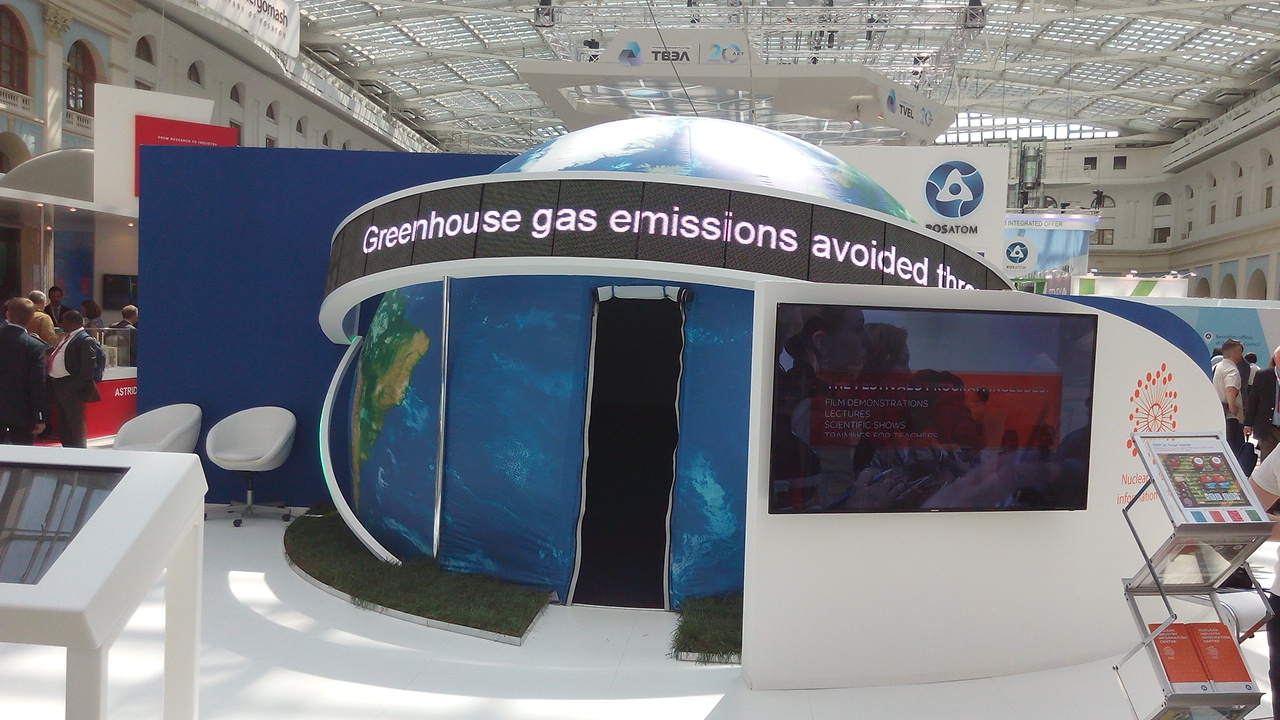
Russia’s State Atomic Energy Corporation (ROSATOM) hosts the annual ATOMEXPO International Forum as a major exhibition and business platform for conducting meetings and negotiations between the worldwide leaders of the nuclear power industry.

The 2016 edition, holding in Moscow from May 30–June 2, provides leaders of nuclear power industry and nuclear power engineering with an opportunity to publicly define the place and role of nuclear generation in the 21st century energy balance.

The Forum also promotes international cooperation between the Russian Federation and the countries of Latin America, Pacific Asia, Africa, Central and Eastern Europe in the field of nuclear power, and to discuss Russia’s proposal on developing national energy programs.

Ghana has representation from the Ministry of Power and the Atomic Energy Commission at the Forum.

In 2013, Ghana announced plans to build a nuclear plant for power generation, which was estimated to take eight years to complete.

With government’s new interest in coal power production, the Ghanaian delegation is expected to explore new opportunities in nuclear power generation in the country’s energy mix, vis-à-vis the environment/climate change, cost and safety concerns of the various energy sources. 

Generating power from thermal and other sources have become unreliable for Ghana to meet industrial needs. The increasing urbanization in will greatly increase the demand for electricity.

Nuclear energy is growing globally with nearly 10 GW of new nuclear capacity supplying electricity in 2015 – more than double the average capacity connected each year in the previous decade.

Though there are long term prospects for nuclear, experts say the emerging nuclear energy countries are not expected to contribute very much to the expansion of nuclear capacity in the foreseeable future.

Story by Kofi Adu Domfeh, in Moscow, Russia

Translate

Popular Posts