...This Agenda is a plan of action for people, planet and prosperity... We are resolved to free the human race from the tyranny of poverty and want and to heal and secure our planet…

Search This Blog

Showing posts with label land degradation. Show all posts

Friday, April 28, 2023

Impacts of climate change are worsening, media identified as ally in public sensitization


The impacts of climate change are worsening as a result of human actions and activities, including indiscriminate felling of trees, water pollution through improper waste disposal, and unsustainable land management.

Educating the public on the dangers of these practices and the need to adopt environmentally sustainable practices are necessary to foster behavioral change and reduce impacts.

The Feed the Future (FTF) Ghana Policy LINK Activity considers the media as an important ally in educating and sensitizing the public on climate change, a phenomenon that threatens livelihoods and economic development.

In partnership with the Environmental Protection Agency (EPA), a capacity enhancement training on climate change and environmental issues was organized for reporters and editors in Ghana.


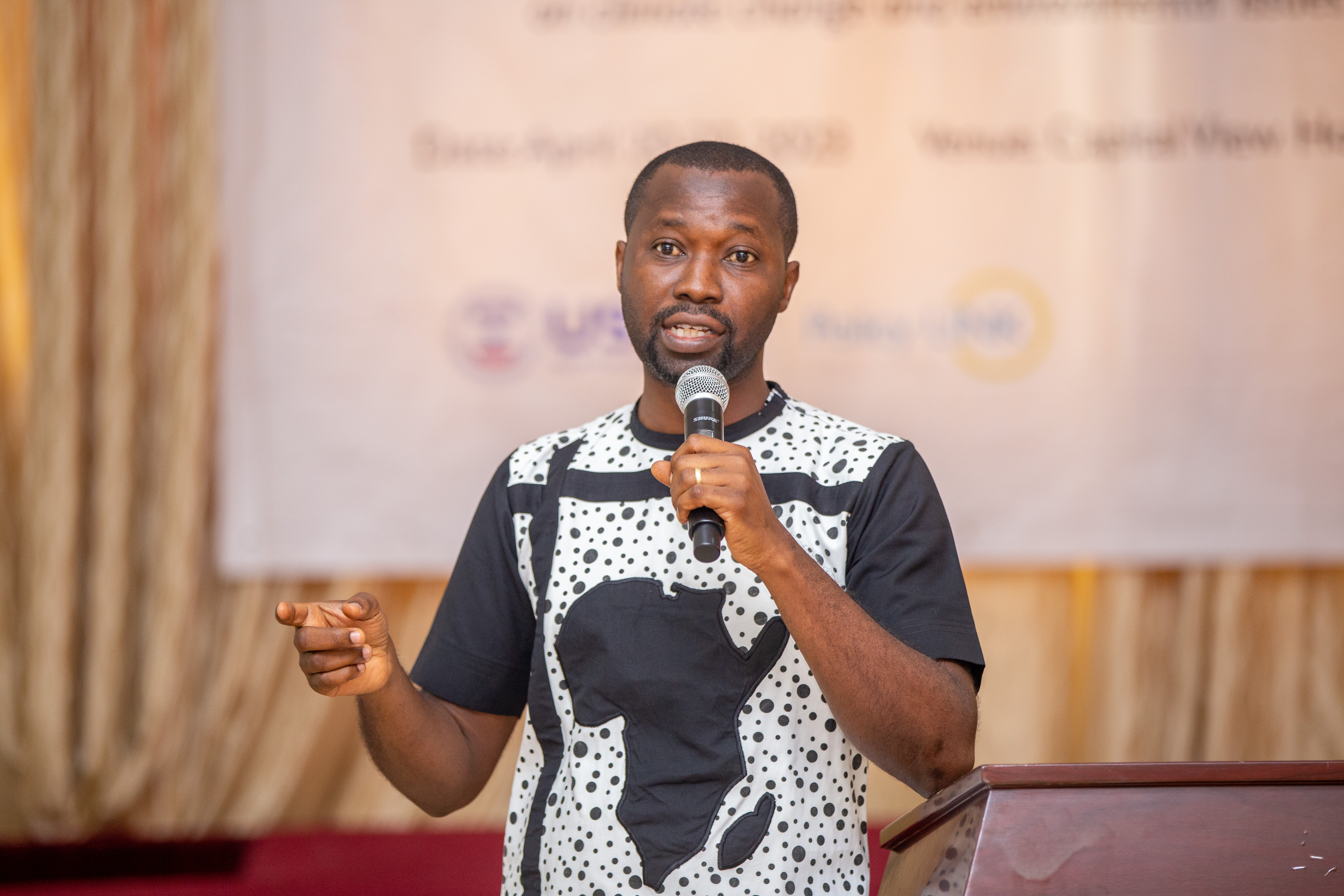
Dr. Gerald Forkuor, Climate Change Lead at Policy LINK, entreated journalists to project indigenous innovations and initiatives that promote climate-smart agriculture.

“The media as key actors for education and sensitization need to increase awareness on climate change issues through accurate reportage, especially in the deployment of technologies by farmers to support their resilience against climate change,” he said.

The media engagement highlighted knowledge of key climate change policies, strategies, and plans on themes such as climate smart agriculture, climate finance, biodiversity, and sustainable land and forest management.

Value of Biodiversity to Agriculture


Dr. Winston Asante, Senior Lecturer at the Faculty of Renewable Natural Resources at the Kwame Nkrumah University of Science and Technology (KNUST), emphasized the value of biodiversity and its contribution to the food and agriculture sector is increasingly being acknowledged in international policy agenda.

“The loss of biodiversity leads to reduced sources of food, structural materials, medicinal and genetic resources,” he observed.

Supplying safe and nutritious food for a growing population poses a number of challenges, especially in increasing food production without jeopardizing the ability of the seas and lands to provide for other essential ecosystem functions and to supply food for future generations.

Biodiversity – the variety of life at genetic, species and ecosystem levels – has been described as vital to efforts to meet the Sustainable Development Goals (SDGs) of the 2030 Agenda.


Dr. Asante spoke about the significant correlation between cocoa yield and water, noting that rainfall is the biggest singular factor influencing distribution of cocoa in Ghana.

“Water and temperature stress in cocoa farms will ultimately trigger and further drive challenges in managing agronomic and other on-farm complexities,” he stated.

Human-induced Degradation  

Due to the effects of management techniques and changes in land use brought on by food and agriculture, food systems are often being undermined.

According to Dr. Kwabena Asubonteng of the Faculty of Natural Resources and Environment, University for Development Studies, population growth, agriculture expansion and deforestation are top drivers of human-induced land degradation.

Activities such as indiscriminate logging, forest burning and unsustainable mining are stresses and land and forests that exacerbate climate change.


Dr. Asubonteng called for the enforcement of laws and policies that restrict certain human activities to help reduce the spate of land degradation.

He also emphasized land restoration as “the process of avoiding, reducing, and reversing land degradation to recover the biodiversity and ecosystem services that sustain all life on earth”.

Climate change policy implementation

The World Meteorological Organisation (WMO) in its annual report: “The State of the Global Climate 2022” has highlighted that the relentless advance of climate change brought more drought, flooding and heatwaves to communities in 2022, compounding threats to people’s lives and livelihoods.

Dr. Daniel Tutu Benefor of Ghana’s Environmental Protection Agency and Focal Person to the UNFCCC says the country is on the path to implementing clear-up climate change policies as a vehicle to achieve the Sustainable Development Goals (SDGs).


The country is exploring opportunities to tap into climate and carbon financing frameworks for its climate mitigation and adaptation programmes.

By Kofi Adu Domfeh


Tuesday, September 4, 2018

Restoring degraded lands for sustainable development and climate resilience

Participants at the Global Landscape Forum (GLF) Nairobi 2018 have reignited the drive to restore at least 12 million hectares annually simply to reach land degradation neutrality.
 
Speakers from across Africa discussed their experiences and successes restoring forests, farms and coastlines for sustainable development, climate mitigation and adaptation.

“Unless urgent and concerted action is taken, land degradation will worsen in the face of population growth, unprecedented consumption, an increasingly globalized economy and climate change,” said Robert Nasi, Director General of the Center for International Forestry Research (CIFOR). “We must restore at least 12 million hectares annually simply to reach land degradation neutrality. And if we want to rectify errors from the past, then we need to run twice as fast.”

Degraded landscapes each year cost 10 percent of the global economy, affecting the livelihoods and wellbeing of some 3 billion people across the world, many in developing countries. The global landscapes community aims to restore more than 2 billion hectares of degraded land worldwide – a footprint larger than South America. For progress to take place, the private and public sectors must invest $350 billion annually.

“We have the necessary technical knowledge to restore landscapes; what is missing is stronger political commitment and better rural governance,” said Stefan Schmitz of the German Federal Ministry for Economic Cooperation and Development. “This includes decentralizing decision-making, administrative capacities and financial resources; putting in place adequate territorial and tenure policies.”

Initiatives big and small, from the AFR100 to local efforts such as mangrove restoration, are demonstrating the potential for greater agricultural yields, ecosystem services and climate protection. At the same time, now is the time to convert commitments to restore hundreds of millions of hectares of land into action by involving communities, women and youth, the speakers said.

“In a degraded landscape, if a woman doesn’t have the firewood, it will be difficult for her to get the water,” said Mukasa. “We managed to bring together six communities using an adaptive collaborative management approach. That vision is over restoration of degraded landscapes. These communities have been able to produce community trees.”

UN Environment Executive Director, Erik Solheim, reiterated his support for a U.N. decade devoted to promoting the rehabilitation of degraded, damaged and destroyed ecosystems to help speed up the race against climate change and biodiversity loss. He urged participants to support the proposal for a U.N. Decade for Ecosystem Restoration 2021-2030, which was first floated by El Salvador.

“Ecosystem restoration can counter climate change, poverty and biodiversity loss,” said Solheim. “A U.N. Decade for Ecosystem Restoration would give us an opportunity to accelerate restoration action and UN Environment supports El Salvador and the many other countries who are champions of this idea.”

GLF Nairobi 2018 also held discussions about ‘The Great Green Wall for the Sahara and Sahel Initiative’, and there was a launch of a documentary and a concert by musician Rocky Dawuni.

Monday, March 26, 2018

Worsening Worldwide Land Degradation Now 'Critical,' Intensifying Climate Change

Worsening land degradation caused by human activities is undermining the well-being of two fifths of humanity, driving species extinctions and intensifying climate change.

It is also a major contributor to mass human migration and increased conflict, according to the world's first comprehensive evidence-based assessment of land degradation and restoration. 

The dangers of land degradation, which cost the equivalent of about 10% of the world's annual gross product in 2010 through the loss of biodiversity and ecosystem services, are detailed for policymakers, together with a catalogue of corrective options, in the three-year assessment report by more than 100 leading experts from 45 countries.

Produced by the Intergovernmental Science-Policy Platform on Biodiversity and Ecosystem Services (IPBES), the report was approved at the 6th session of the IPBES Plenary in MedellĂ­n, Colombia. IPBES has 129 State Members. 

Providing the best-available evidence for policymakers to make better-informed decisions, the report draws on more than 3,000 scientific, Government, indigenous and local knowledge sources. Extensively peer-reviewed, it was improved by more than 7,300 comments, received from over 200 external reviewers. 

Serious Danger to Human Well-being

Rapid expansion and unsustainable management of croplands and grazing lands is the most extensive global direct driver of land degradation, causing significant loss of biodiversity and ecosystem services - food security, water purification, the provision of energy and other contributions of nature essential to people. This has reached 'critical' levels in many parts of the world, the report says.

"With negative impacts on the well-being of at least 3.2 billion people, the degradation of the Earth's land surface through human activities is pushing the planet towards a sixth mass species extinction," said Prof. Robert Scholes (South Africa), co-chair of the assessment with Dr. Luca Montanarella (Italy). "Avoiding, reducing and reversing this problem, and restoring degraded land, is an urgent priority to protect the biodiversity and ecosystem services vital to all life on Earth and to ensure human well-being."

"Wetlands have been particularly hard hit," said Dr. Montanarella. "We have seen losses of 87% in wetland areas since the start of the modern era - with 54% lost since 1900." 

According to the authors, land degradation manifests in many ways: land abandonment, declining populations of wild species, loss of soil and soil health, rangelands and fresh water, as well as deforestation. 

Underlying drivers of land degradation, says the report, are the high-consumption lifestyles in the most developed economies, combined with rising consumption in developing and emerging economies. High and rising per capita consumption, amplified by continued population growth in many parts of the world, can drive unsustainable levels of agricultural expansion, natural resource and mineral extraction, and urbanization - typically leading to greater levels of land degradation. 

By 2014, more than 1.5 billion hectares of natural ecosystems had been converted to croplands. Less than 25% of the Earth's land surface has escaped substantial impacts of human activity - and by 2050, the IPBES experts estimate this will have fallen to less than 10%. 

Crop and grazing lands now cover more than one third of the Earth´s land surface, with recent clearance of native habitats, including forests, grasslands and wetlands, being concentrated in some of the most species-rich ecosystems on the planet.

The report says increasing demand for food and biofuels will likely lead to continued increase in nutrient and chemical inputs and a shift towards industrialized livestock production systems, with pesticide and fertilizer use expected to double by 2050. 

Avoidance of further agricultural expansion into native habitats can be achieved through yield increases on the existing farmlands, shifts towards less land degrading diets, such as those with more plant-based foods and less animal protein from unsustainable sources, and reductions in food loss and waste.

Strong Links to Climate Change

"Through this report, the global community of experts has delivered a frank and urgent warning, with clear options to address dire environmental damage," said Sir Robert Watson, Chair of IPBES.  

"Land degradation, biodiversity loss and climate change are three different faces of the same central challenge: the increasingly dangerous impact of our choices on the health of our natural environment. We cannot afford to tackle any one of these three threats in isolation - they each deserve the highest policy priority and must be addressed together."

The IPBES report finds that land degradation is a major contributor to climate change, with deforestation alone contributing about 10% of all human-induced greenhouse gas emissions. Another major driver of the changing climate has been the release of carbon previously stored in the soil, with land degradation between 2000 and 2009 responsible for annual global emissions of up to 4.4 billion tonnes of CO2. 

Given the importance of soil's carbon absorption and storage functions, the avoidance, reduction and reversal of land degradation could provide more than a third of the most cost-effective greenhouse gas mitigation activities needed by 2030 to keep global warming under the 2°C threshold targeted in the Paris Agreement on climate change, increase food and water security, and contribute to the avoidance of conflict and migration.  

Projections to 2050

"In just over three decades from now, an estimated 4 billion people will live in drylands," said Prof. Scholes. "By then it is likely that land degradation, together with the closely related problems of climate change, will have forced 50-700 million people to migrate. Decreasing land productivity also makes societies more vulnerable to social instability - particularly in dryland areas, where years with extremely low rainfall have been associated with an increase of up to 45% in violent conflict."

Dr. Montanarella added: "By 2050, the combination of land degradation and climate change is predicted to reduce global crop yields by an average of 10%, and by up to 50% in some regions. In the future, most degradation will occur in Central and South America, sub-Saharan Africa and Asia - the areas with the most land still remaining that is suitable for agriculture." 

The report also underlines the challenges that land degradation poses, and the importance of restoration, for key international development objectives, including the United Nations Sustainable Development Goals and the Aichi Biodiversity Targets. "The greatest value of the assessment is the evidence that it provides to decision makers in Government, business, academia and even at the level of local communities," said Dr. Anne Larigauderie, Executive Secretary of IPBES. "With better information, backed by the consensus of the world's leading experts, we can all make better choices for more effective action."

Options for Land Restoration

The report notes that successful examples of land restoration are found in every ecosystem, and that many well-tested practices and techniques, both traditional and modern, can avoid or reverse degradation. 

In croplands, for instance, some of these include reducing soil loss and improving soil health, the use of salt tolerant crops, conservation agriculture and integrated crop, livestock and forestry systems. 

In rangelands with traditional grazing, maintenance of appropriate fire regimes, and the reinstatement or development of local livestock management practices and institutions have proven effective. 

Successful responses in wetlands have included control over pollution sources, managing the wetlands as part of the landscape, and reflooding wetlands damaged by draining. 

In urban areas, urban spatial planning, replanting with native species, the development of 'green infrastructure' such as parks and riverways, remediation of contaminated and sealed soils (e.g. under asphalt), wastewater treatment and river channel restoration are identified as key options for action.       

Opportunities to accelerate action identified in the report include: 
  • Improving monitoring, verification systems and baseline data;
  • Coordinating policy between different ministries to simultaneously encourage more sustainable production and consumption practices of land-based commodities;
  • Eliminating 'perverse incentives' that promote land degradation and promoting positive incentives that reward sustainable land management; and
  • Integrating the agricultural, forestry, energy, water, infrastructure and service agendas.
Making the point that existing multilateral environmental agreements provide a good platform for action to avoid, reduce and reverse land degradation and promote restoration, the authors observe, however, that greater commitment and more effective cooperation is needed at the national and local levels to achieve the goals of zero net land degradation, no loss of biodiversity and improved human well-being.

Knowledge Gaps

Among the areas identified by the report as opportunities for further research are:
  • The consequences of land degradation on freshwater and coastal ecosystems, physical and mental health and spiritual well-being, and infectious disease prevalence and transmission;
  • The potential for land degradation to exacerbate climate change, and land restoration to help both mitigation and adaptation;
  • The linkages between land degradation and restoration and social, economic and political processes in far-off places; and
  • Interactions among land degradation, poverty, climate change, and the risk of conflict and of involuntary migration.
Environmental and Economic Sense

The report found that higher employment and other benefits of land restoration often exceed by far the costs involved.  On average, the benefits of restoration are 10 times higher than the costs (estimated across nine different biomes), and, for regions like Asia and Africa, the cost of inaction in the face of land degradation is at least three times higher than the cost of action.

"Fully deploying the toolbox of proven ways to stop and reverse land degradation is not only vital to ensure food security, reduce climate change and protect biodiversity," said Dr. Montanarella, "It's also economically prudent and increasingly urgent."

Echoing this message, Sir Robert Watson, said: "Of the many valuable messages in the report, this ranks among the most important: implementing the right actions to combat land degradation can transform the lives of millions of people across the planet, but this will become more difficult and more costly the longer we take to act." 

Monday, December 7, 2015

Two initiatives to restore 100million hectares of land to combat climate change in Africa

Two ambitious initiatives to restore 100 million hectares of degraded and deforested land in Africa by 2030 have been launched at the Global Landscape Forum, organized alongside the UNFCCC COP21 in Paris.

The Forum created a platform for positioning landscapes in the new international agreements on climate and sustainable development.

The African Forest Landscape Restoration Initiative – dubbed AFR100 – is a pan-African, country-led effort endorsed by the African Union with ten countries so far agreeing to commit at least 31.7 million hectares for the restoration.

The countries include the Democratic Republic of Congo, Ethiopia, Kenya, Liberia, Madagascar, Malawi and Niger. Others are Rwanda, Togo and Uganda.

“Restoring our landscapes brings prosperity, security and opportunity,” said Dr. Vincent Biruta, Minister of Natural Resources in Rwanda. “With forest landscape restoration we’ve seen agricultural yields rise and farmers in our rural communities diversify their livelihoods and improve their well-being. Forest landscape restoration is not just an environmental strategy, it is an economic and social development strategy as well.”

AFR100 partners – including the AU’s NEPAD Agency, the World Resources Institute and the German Government – are earmarking more than $1billion in development finance and additional $540 million in private sector impact investment to support restoration activities.

“The scale of these new restoration commitments is unprecedented,” said Wanjira Mathai, Chair of the Green Belt Movement and daughter of Nobel Peace Prize Laureate Wangari Maathai. “I have seen restoration in communities both large and small across Africa, but the promise of a continent-wide movement is truly inspiring.  Restoring landscapes will empower and enrich rural communities while providing downstream benefits to those in cities. Everybody wins. ”  

AFR100 recognizes the benefits that forests and trees can provide in African landscapes: improved soil fertility and food security, greater availability and quality of water resources, reduced desertification, increased biodiversity, green jobs, economic growth, and increased capacity for climate change resilience and mitigation. 

Commitments made through Initiative build on significant climate pledges made by many African countries to support a binding global climate agreement.

So far, 13 of the Intended Nationally Determined Contributions submitted by African countries include restoration, conservation of standing forests, or “climate-smart” agriculture.

The AFR100 will work alongside the African Resilient Landscapes Initiative (ARLI) which leverages previous experience from Africa-led partnerships such as TerrAfrica.

“The ARLI will mobilize African countries and partners to leverage sectorial interventions and collectively ensure the integrity, resilience, restoration and sustainable management of landscapes across regions,” said Dr. Ibrahim Assane Mayaki, CEO of NEPAD. “We need to scale up restoration across the whole continent – more than 700 million hectares of land in Africa have potential for restoration. AFR100 provides a platform to work together more effectively to accelerate the achievement of restoration successes to benefit tens of millions of people who are currently searching for ways to adapt to climate change and improve their well-being”.

The ARLI will be implemented through the African Landscapes Action Plan, a roadmap prepared by the African Union NEPAD and partners from the Landscapes for People, Food and Nature Initiative to advance landscape governance, research, and finance through priority actions that embrace all land actors and all sectors.

“Sustainably developing the drylands and conferring resilience to their inhabitants will require addressing a complex web of economic, social, political, and environmental vulnerabilities,” said Makhtar Diop, Vice President for Africa Region, World Bank Group. “Good adaptive responses have the potential to generate new and better opportunities for many people, cushion the losses for others, and smooth the transition for all. Implementation of these responses will require effective and visionary leadership at all levels.”
 
The ARLI and its supporting initiatives will contribute to improved soil fertility and food security, improve access to clean water, combat desertification, increase biodiversity and habitat, create green jobs, bolster economic growth and livelihood diversification, and increase the capacity for climate change resilience and adaptation.

Dr. Andrew Steer, President and CEO, World Resources Institute, describes restoration as Africa’s gift to the world.

“As the world forges a climate agreement in Paris, African countries— which bear the least historic responsibility for climate change-- are showing leadership with ambitious pledges to restore land. These countries are well on their way to meet the goal of restoring 100 million hectares of land, which will help sequester carbon and bring economic benefits to low-income, rural communities. These African leaders are turning their words into action and making a real contribution to respond to the global threat of climate change,” he said.

Story originally commissioned by Vita International

Translate

Popular Posts